Tuesday, 19 August 2014
Do Men Cause Wars?
My posted reply to the Inside Man article titled 'Do Men Start Wars'
You use the word 'start', by which you must mean either 'cause' or 'declare'.
We all know that some men have declared war and that some women have also done so. The question of whether men cause wars is a more interesting one.
Every claim about causation entails a corresponding counterfactual claim.
“An arsonist caused my house to burn down.” (Claim)
“If there had been no arsonist, my house would not have burned down.” (Counterfactual)
So to answer whether “Men cause wars”, we can ask the counterfactual question “If there had never been men, would there have been wars?” However the answer is, of course, no; there would not be any humans if only one gender existed.
So we should ask something else.
“Does male leadership cause wars?” (Claim)
“If there were no male leadership, would there have been (as many) wars?” (Counterfactual)
Ignoring the possibility of no leadership at all; hence assuming female leadership. From history, it seems like female leadership would cause at least as many wars as male leadership does.
Margaret Thatcher: Falklands War
Indira Gandhi: Indo-Pakistan War
Golda Mier: Yom Kippur War
Elizabeth I of England: Nine Year’s War, Irish War, Elizabethan War
Anna of Russia: War of Polish Succession, Russo-Turkish War
Elizabeth of Russia: War of Austrian Succession, Seven-Year’s War
Catherine the Great: Russo-Persian War
A look through English and Russian history confirms that most female leaders have declared war. I don’t know about the history of other nations. More recently, Hillary Clinton voted for war.
It seems that men do not “cause” wars anymore than women do.

Sunday, 3 August 2014
Contra Patriarchy - Part 1: The women of I♥IDF who used sex in order to encourage men to kill for them.
There are some men who use women to attain their ends. Indeed, I suspect that almost all people have once used at least one member of their own sex, and of the opposite sex, in order to attain some selfish end. However, some academic feminists claim that modern women lack the means to use men in order to attain their ends. I deny that claim; I contend that modern women can, and do, use men in order to attain their ends. I've published this entry, as the first of two parts, in order to corroborate that contention.
_______________________
Some women have, and do, use sex to manipulate men in order to attain their ends.
Consider a popular1 grassroots campaign, 'I♥IDF', whose participants endeavour to bolster the morale of the IDF's (Israeli Defense Force) male2 combatants in Gaza by uploading sexual photographs of themselves to social media websites (see below).
Recent survey data indicates that 73% of Israeli women3 desire that the mission in Gaza continue until Hamas surrenders. In this entry, I have included a sample of the images uploaded by the campaign's participants, which collectively depict 60 different participants4. There is virtually no chance (1 in 1036) that none of those participants desire that the mission in Gaza continue until Hamas surrenders.
I cannot remember an instance of a person voluntarily abetting someone in order that the abetted might effect a state of affairs that the abettor did not hope would obtain. Accordingly, I believe that I may reasonably presume that when a person voluntarily abets another person, the abettor usually does so in order that the abetted might effect a state of affairs that the abettor hopes will obtain. In other words, common sense suggests that the I♥IDF participants hope that their campaign will, directly or indirectly, increase the chance that the IDF compels Hamas to surrender.
In conclusion, there is, almost certainly, one participant in the I♥IDF campaign who used a sexual photograph of herself in order to encourage men to do what she desired them to do. Accordingly, there is, almost certainly, at least one woman who manipulates men in order to attain her ends. Assuming such manipulations succeed (the contrary assumption depreciates the judgement of these women), then the academic-feminist cannot claim that modern-women lack the means to manipulate men.


[1]Well known newspapers covered the campaign.
[1][a]Jezebel
[1][b]Salon
[1][c]BBC
[1][d]Huffington Post
[2]Men constitute 97% of the IDF's combatants.
[3] Recent survey data indicates that approximately 86% of Israelis desire the mission in Gaza to continue until Hamas surrenders. Accordingly, if we assume the population of Israel comprises equal numbers of men and women, then if every member of one sex expressed the aforementioned desire, 73% of the other sex would have indicated the same desire. In the interest of conservatism, I've assumed, the least favourable possibility for this argument, that 73% of Israeli women expressed the aforementioned desire.
[4]I assume that there is no person depicted more than once in the 60 included images. However, the image in the second column of the first row of the second mosaic depicts three people, so the photographs possibly collectively-depict 62 people.
Friday, 25 July 2014
Elite Misandrists I: Jan Johnstone of Ontario's NDP and Twitter's Id Johnson
A tweet from Canadian Politician representing the New Democratic Party in the Heron-Bruce constituency and Bluewater Bay School Board Trustee, Jan Johnstone

Jan Johnstone of Ontario's NDP implicates, rather explicitly, that she doesn't care about men. Ms.Jan Johnstone dismissed, out of hand, the lost lives of 3600 Native Canadian men. Before you vote on the people we send to Queen's Park, and on the people you want directing the education of your children, please consider Jan Johnstone's reply and ask yourself whether you believe Jan Johnstone cares equally about every life, regardless of the sex of the person living it.
The following image is a screen-grab of a conversation with a Twitter user who uses the handle Id Johnson. If you look closely at her user-image you'll see it has a number of venus-symbols stuck in the ground like gravestones and bears the caption 'Stop Violence against Women and Girls'. Evidently, like Jan Johnstone of Ontario's NDP, Id Johnson doesn't care about the well-being of men either:
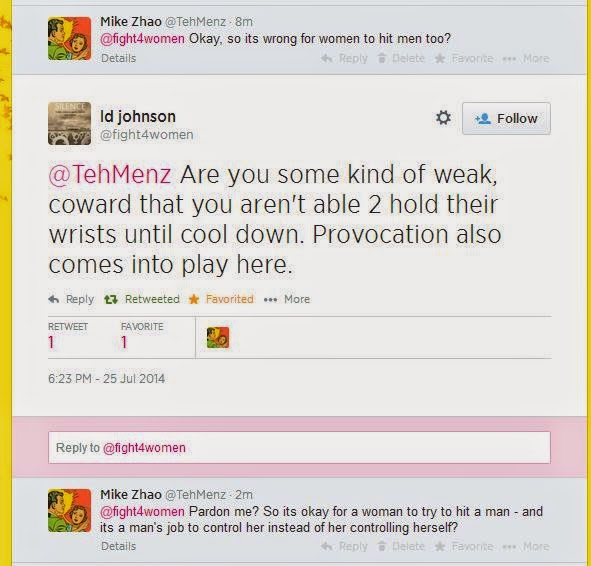
When I asked Id Johnson whether she thought we ought to accept women hitting men, she asked me whether I regarded myself as a weak coward who could not physically restrain my partner until she 'cooled down', thereby implicating her conviction that society ought to accept female-on-male violence, and that society ought to expect men to restrain women instead of expecting women to restrain themselves.
Friday, 18 July 2014
Passing from Virginity. An Open Letter to Charly Lester of the Huffington Post.
Dear Ms. Lester,
Thank you for helping to break the silence surrounding male rape.
I was raped by my first sexual partner when I was 17. I had snuck into her parents house with her late one night. We filled about an hour with the sort of pseudo-sex that precedes non-virginhood before she asked me to have sex with her. I refused: partially for fear of waking her parents, and partially for my desire for my first instance of 'real sex' to happen in a safer environment. She protested, I refused again, and she answered by threatening to wake her parents, who I had felt scared around fully dressed, to say nothing of how I would have felt had they come to investigate and found me struggling to don my underwear. She won. She assured me that I didn't have anything to worry about, and that she'd do the work - as though that would help me relax. Ultimately, she mounted me and I passed from virginhood.
I judged it worth writing you about this event, as a major part of breaking the silence surrounding male rape involves engendering the acceptance, but not the tolerance, of instances of the heterosexual-rape of boys. I hope you will someday write an article that promotes awareness of such events.
Thank you for helping to obliterate this taboo.
-Michael.
Thursday, 17 July 2014
How to Present Men's Issues. Part II: Using feminist premises to derive the importance of MIA
In Part 1 I wrote about acknowledging some of the achievements of feminists, and the important work some of its constituents still undertake. The goal of one of those undertakings is to ensure that women constitute a proportionate number of our law makers, thereby ensuring legislation benefits women as much as it benefits men.
Essentially, that belief entails the belief that the members of each sex should advocate for the members of their sex: women understand women best, and men understand men best, so let women ensure that the law fulfills women's needs and let men ensure that the law fulfills men's needs. Hence, given the common presumption that the feminist movement inherently comprises mostly women, the MIA can argue for the importance of a non-feminist movement that advocates for men's well-being thus:
MIA: Men know men better than women know men, and women know women better than men know women, so despite men's best intentions, women can present women's concerns to the legislature better than men can present women's concerns to it?
FEM: Yes, that's right.
MIA: So if the legislature comprises fewer females than males, then the laws it enacts will not benefit women as much as they might have benefited them had the legislature comprised more females?
FEM: Right.
MIA: So the legislature ought to comprise an equal number of males and females in order that it might enact laws that maximally benefit both sexes?
FEM: Exactly.
MIA: Makes sense. Now, if a person knows the issues that concern his or her own sex better than a member of the opposite sex knows them, and if that knowledge enables him or her to resolve those issues better than a member of the opposite sex might resolve them, then we would want to ensure that men participate in discussions about the issues that concern men as much as women participate in discussions about the issues that concern women; correct?
After that, the feminist has a limited number of rejoinders, which I will list below with their corresponding replies.
FEM: Feminism allows men to participate.
MIA: Interesting. And it works for the equality of both sexes?
FEM: It does, yes.*
MIA: So feminism would want to resolve men's issue xyz?
FEM: Yes.**
MIA: Would feminism also want to resolve men's issue abc?
FEM: Yes.**
MIA: Well that's what MIA undertakes to resolve, so feminism and MIA seem compatible.
*Suppose FEM replies, No it mostly undertakes to improve women's status. The MIA may rebutt, I suppose that comports with what you had said about the legislature - women can resolve women's concerns better than men can, and vice versa. That's a reason for MIA.
** Suppose FEM replies, No. The MIA may ask, Do you think it's okay that xyz happens to men?Regardless of her answer to that question, the MIA may answer, That's a reason for MIA.
Alternatively, the feminist may decided to argue that men's issue xyz affects women more than it affects men. In Part III, I'll describe how to rebut such arguments.
Sunday, 13 July 2014
How to Present Men's Issues. Part I: Give credit where credit is due.
There is an especially active feminist cohort at my university; consequently, I've had, and have made use of, a number of opportunities to discuss the advocacy of men's issues with the people most likely to oppose it. In so doing I've learned a number of useful techniques for effectually presenting the subject. The next five entries will describe those techniques.
Part I
Part I
I noticed two things about my first debate with a feminist about the merits of men's issues advocacy:
- She seemed to want me to concede that men's behaviour had harmed women more than women's behaviour had harmed men.
- I seemed to want her to concede the opposite.
Perhaps more interestingly, most of the feminists with whom I've discussed men's issues advocacy have asked me why I wanted to destroy feminism. I wondered why they suspected that I wanted that. I had never wanted that, so the question surprised me. In any case, it seems that many feminists fear that the advocacy of men's issues will harm their sub-culture.
I've succeeded in allaying the aforementioned concerns by expressing my appreciation of the historical accomplishments of feminism, such as
- the abolishment of laws that denied fundamental liberties to half our population, and
- the attenuation of gender roles which increased the number of socially acceptable ways that men, and women, might participate in the commercial and domestic economies,
and by acknowledging the importance of contemporary feminist undertakings, such as
- promoting women's entitlement to their human rights in jursidictions where women do not enjoy them, and
- ensuring that women constitute a proportionate number of our law makers, thereby ensuring legislation benefits men and women equally.
Moreover, acknowledgement of the importance of these undertakings produces a set of premises that both parties accept; without such a set of premises, agreement is a logical impossibility.
In Part II, I will describe how these premises imply the importance of men's issues advocacy.
In Part II, I will describe how these premises imply the importance of men's issues advocacy.
Saturday, 12 July 2014
Recent issues of The Citizen suggest a paucity of popular concern for the well-being of men
Dear Editor,
Recent issues of The Citizen suggest a paucity of popular concern for the well-being of men:
In May, The Citizen published stories about the number of missing or murdered aboriginal women[1]; none of those stories reported that the lives of native men end by homicide three times more often than the lives of native women do. [2]
More recently, The Citizen published a story subtitled "The pimps they're the problem, the women we are the tragedy" [3]. Tragedy may characterize the lives of many sex-workers. However, not only women live such lives. Abuse, and debasement must affect many male sex-workers. The article also suggests that we ought to attribute the prostitutes' crimes to her circumstances and unconditionally exculpate her. Yet, we wouldn't, and don't, do that for crimes predominantly perpetrated by men trapped in comparably desperate circumstances.
Finally, yesterday, The Citizen published an article titled "Free buses deliver children to moms in prison" [4] and an article titled "Ex-teacher shouldn't see jail for sexually exploiting student"[5]; the latter reported an argument in favour of the convicted escaping a prison sentence so that she could live with her children. In contrast, only two months ago, the Citizen reported that while Chris Haore, accused of assault, awaits his trial, he might have only "supervised access to his five children...if it happens at all." [6] These three articles suggest to me that we generally regard maternal relationships as more valuable than paternal relationships. Yet, I think most people would agree that fathers love their children as much as mothers do.
Commendably, the cited articles promote compassion for female victims, dependents, and perpetrators of crime. However, I can not think of a justification for limiting that compassion to one sex.
Commendably, the cited articles promote compassion for female victims, dependents, and perpetrators of crime. However, I can not think of a justification for limiting that compassion to one sex.
Yours truly,
Michael Zhao
Men's Issues Society at Carleton University
[1]a)http://www.ottawacitizen.com/news/Aboriginal+women+over+represented+murder+statistics+RCMP/9846399/story.html
[1]b)http://www.ottawacitizen.com/news/Case+closed+missing+murdered+aboriginal+women/9850627/story.html
[2]http://www.statcan.gc.ca/pub/89-503-x/2010001/article/11442/tbl/tbl013-eng.htm
[3]http://ottawacitizen.com/news/local-news/a-night-at-ottawas-john-school-the-pimps-theyre-the-problem-the-women-we-are-the-tragedy
[4]http://www.ottawacitizen.com/life/Free+buses+deliver+children+moms+prison/9826674/story.html
[5]http://ottawacitizen.com/news/local-news/ex-teacher-shouldnt-see-jail-for-sexually-exploiting-student-lawyer-argues
[5]http://ottawacitizen.com/news/local-news/ex-teacher-shouldnt-see-jail-for-sexually-exploiting-student-lawyer-argues
[6]http://www.ottawacitizen.com/news/Bail+denied+Ottawa+real+estate+agent+accused+attacking+wife/9767085/story.htm
Subscribe to:
Posts (Atom)